— SERVICE
Trail Cutting in Eastern NC
Trail cutting is for landowners who need better access through wooded, overgrown, or rural property. Whether you want hunting trails, walking paths, ATV and side-by-side access, farm lanes, perimeter trails, or access routes through acreage, Wildwood Eco Solutions can help open up practical paths through brush, saplings, vines, and small trees.
Trail cutting is similar to forestry mulching because much of the material can be processed in place and left as a natural mulch layer. The difference is that trails usually need to be laid out with purpose. Width, turns, slopes, wet areas, drainage crossings, visibility, and how the trail will be used all matter.
A good trail does more than just get you from one point to another. It should fit the land, drain reasonably well, avoid problem areas where possible, and give you access without clearing more than necessary.
— HOW IT WORKS
What it looks like
A trail cutting project usually starts by talking through what the trail is for. A walking trail does not need the same width or turning room as a side-by-side trail. A hunting access trail may need to stay tucked in and quiet, while a perimeter trail may need to be wider and easier to maintain. A trail for tractors, ATVs, or equipment access may need more attention to width, slope, and turning radius.
Once the goal is clear, we look at the property layout, access points, terrain, vegetation density, wet areas, drainage ditches, creek crossings, existing paths, and any trees or areas that should be avoided. If the route is already marked, that helps. If not, we can talk through a practical route during the site visit.
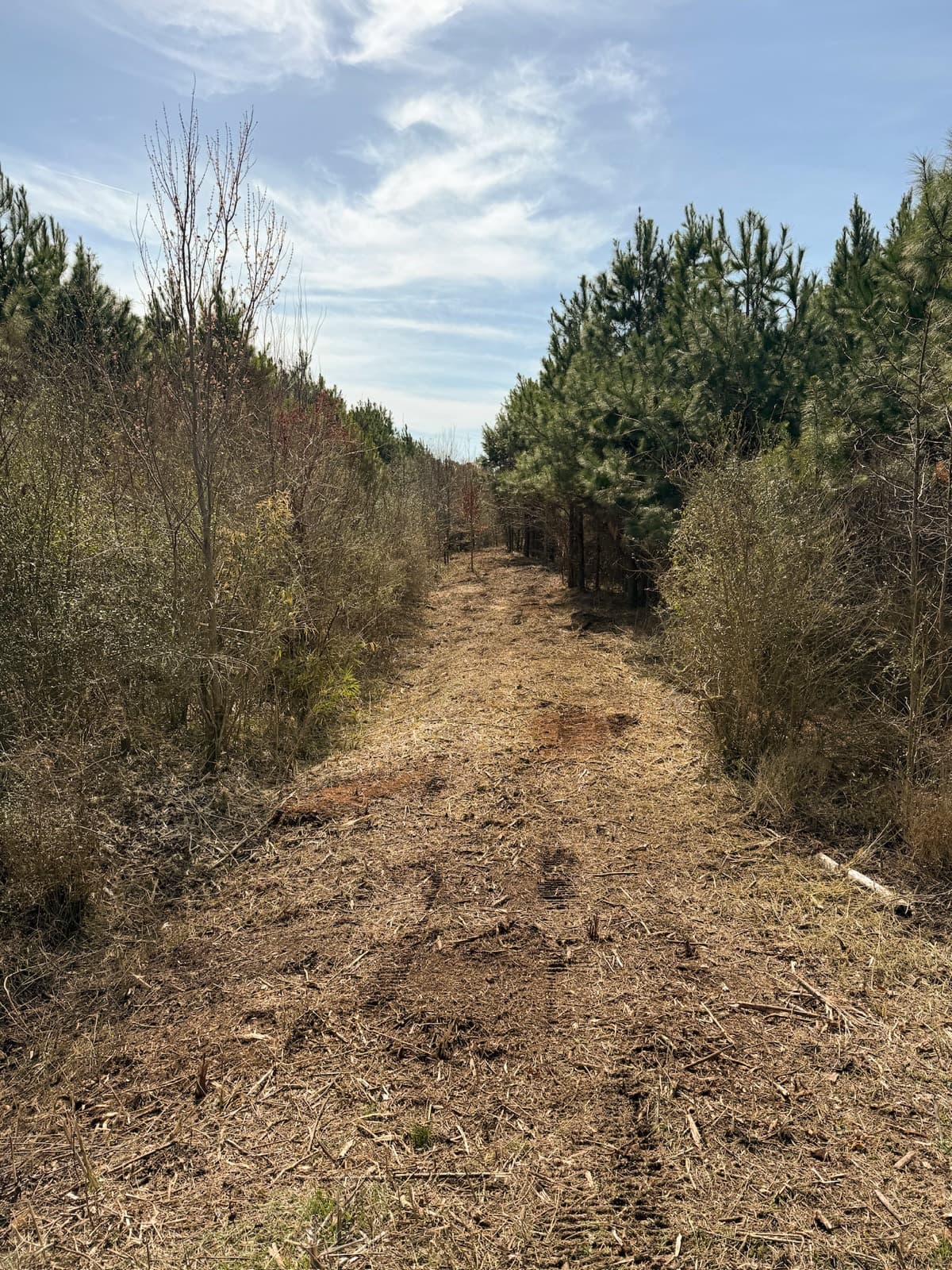
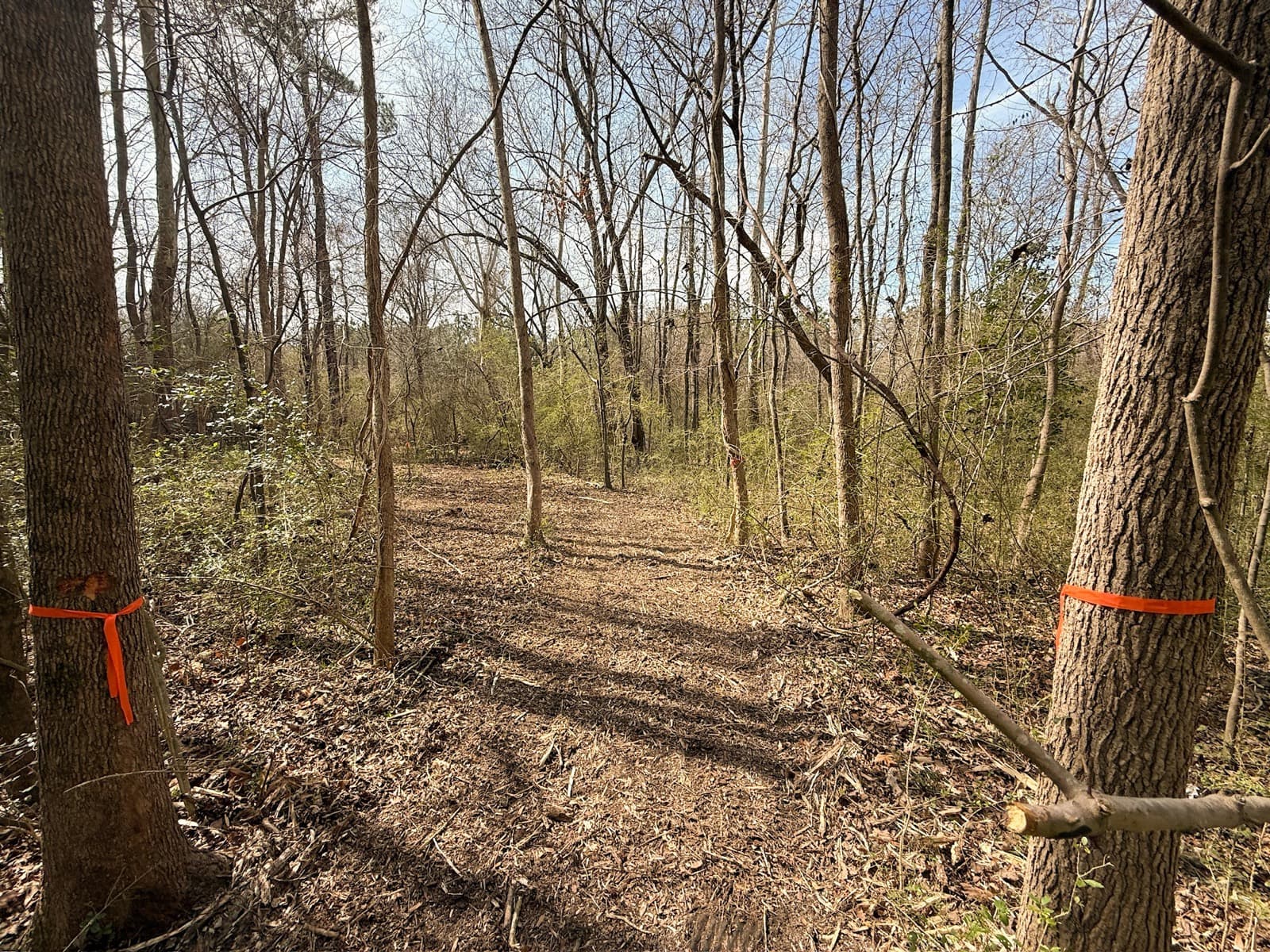
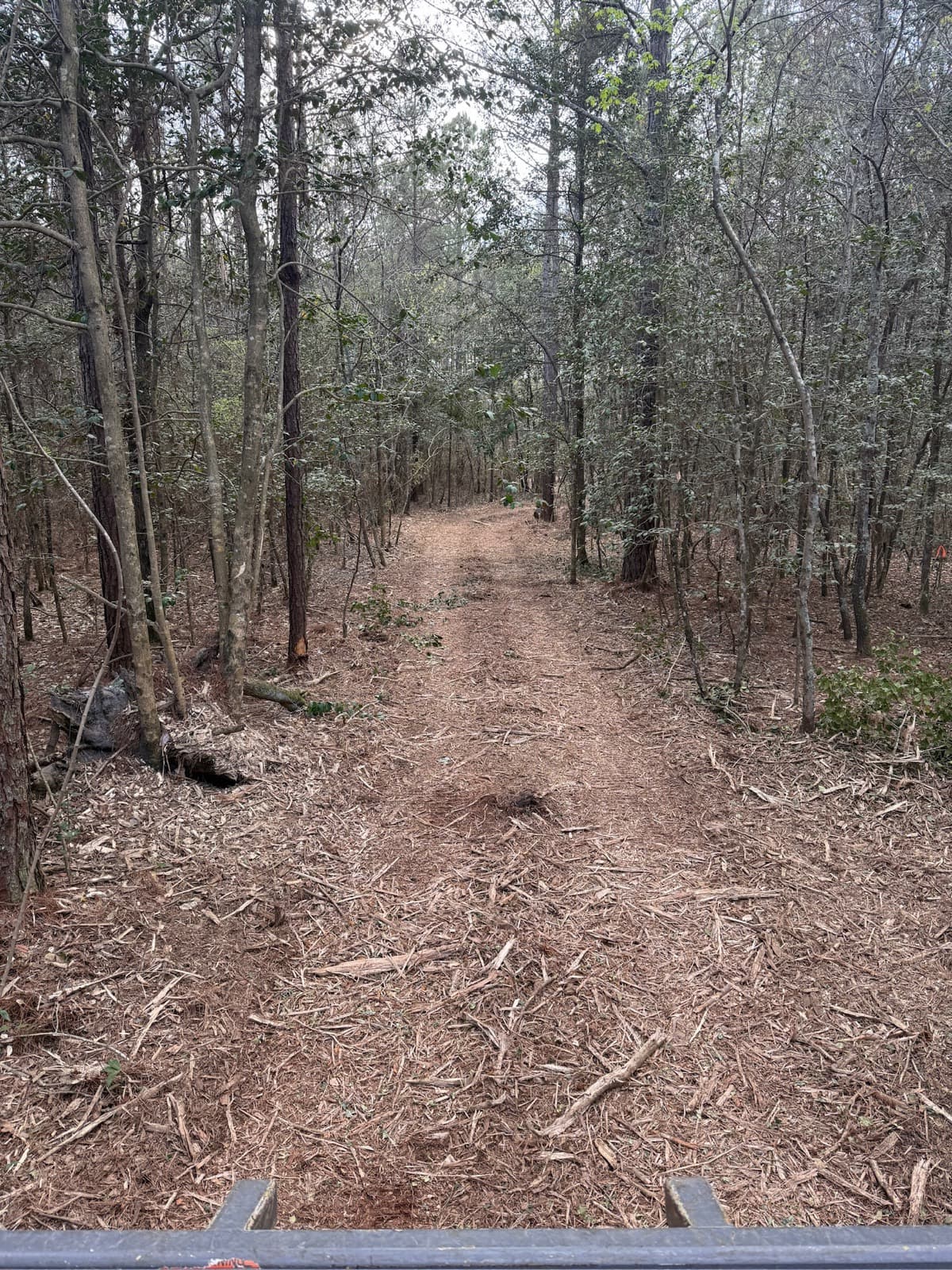
On most trail jobs, we use compact track equipment with a forestry mulching head to process brush, vines, briars, saplings, small trees, and some fallen trees along the route. The material is typically mulched in place, leaving a natural surface that blends into the property better than a scraped or bulldozed path.
Trail cutting may include:
- Opening new trails through brush or woods
- Reclaiming old trails that have grown back in
- Widening existing paths for ATV, UTV, or equipment access
- Cutting perimeter trails around property edges
- Creating hunting access trails
- Clearing walking or recreational paths
- Improving access to stands, fields, ponds, creeks, or back acreage
- Mulching fallen trees or storm debris along the route where practical
The finished trail can be narrow and natural, wide enough for side-by-sides, or more open for maintenance access. The right width depends on how you plan to use it.
— WHEN IT FITS
When it's the right call
Trail cutting is usually a good fit when you want to:
- Create access through overgrown acreage
- Build ATV, UTV, or side-by-side trails
- Open hunting trails to stands, food plots, or property edges
- Reclaim old trails that have grown back in
- Create walking paths or recreational trails
- Cut perimeter trails for inspection or maintenance
- Improve access to ponds, fields, creeks, or back portions of the property
- Clear paths without bulldozing or disturbing more ground than necessary
- Leave a natural mulch surface instead of bare scraped soil
- Make your land easier to use, enjoy, and maintain
— WHEN IT DOESN’T
When it's not the right call
Trail cutting may not be the right service if you need a finished gravel road, a fully graded driveway, a permitted access road, major drainage improvements, culverts, bridge work, or heavy excavation. Trail cutting can open a path, but it is not the same as constructing a road.
It may also not be the best option in wet areas, drainage ditches, creek crossings, steep slopes, or soft ground. We can often work around problem areas, but forcing a trail through the wrong place can create ruts, erosion, stuck equipment, and language you probably do not want repeated in church.
Trail work also needs some flexibility. The best route on paper is not always the best route on the ground. A slight bend around a wet spot, a large tree, a ditch, or a steep slope can make the trail more usable and easier to maintain long term.
If you need the trail to follow an exact property line, that line should be clearly marked or surveyed before work begins. Phone GPS and mapping apps can help with general guidance, but they are not a substitute for marked boundaries.
— WHAT IT COSTS
Pricing
Trail cutting costs depend on trail length, trail width, vegetation density, tree size, terrain, access, wet areas, slopes, fallen trees, and how finished you want the trail to be.
For basic mulched trails, the forestry mulching calculator can help give you a rough starting point if you know the approximate area to be cleared. To estimate trail acreage, multiply the trail width by the trail length, then divide by 43,560 square feet per acre.
For example:
Trail width × trail length ÷ 43,560 = approximate acres
A 12-foot-wide trail that is 1,000 feet long would be:
12 × 1,000 ÷ 43,560 = 0.28 acres
$1,200–$4,800
That acreage can give you a rough starting point for basic mulching. However, trails are not always priced exactly like open-area forestry mulching. Curves, tight turns, selective clearing, wet areas, downed trees, narrow access, route layout, and the intended trail use can all affect the final price.
A straight trail through light brush is one thing. A winding side-by-side trail through thick saplings, vines, slopes, and fallen timber is a different animal. The calculator can help with a starting range, but a site visit is the best way to confirm the route, width, access, and final scope.
— GALLERY
Recent work
— QUESTIONS
Frequently asked
- How wide should a trail be?
- It depends on how you plan to use it. A walking trail may only need a few feet of width. ATV and side-by-side trails commonly need more room, especially around turns. Equipment access, maintenance trails, and perimeter paths may need to be wider. During a site visit, we can talk through the right width based on your use.
- Can I use the forestry mulching calculator for trail cutting?
- Yes, for a rough starting point. If you know the approximate trail width and length, multiply them together to get square feet, then divide by 43,560 to estimate acres. That can help you use the calculator for basic mulched trails. Just keep in mind that trail layout, curves, terrain, wet areas, and site conditions can change the final price.
- Can you cut ATV or side-by-side trails?
- Yes. ATV and side-by-side trails are a common fit for forestry mulching and trail cutting. We’ll want to know the approximate vehicle width, how much clearance you want, and whether the trail needs tight turns, loops, access to stands, or connections to existing paths.
- Do you remove stumps from trails?
- Basic trail cutting and forestry mulching typically cut vegetation near ground level but do not fully remove stumps or root systems. For many natural trails, that may be fine. If you need a smoother trail with stumps removed or ground below grade, that should be discussed as a separate scope.
- Can you follow a trail route that I mark ahead of time?
- Yes, and that is usually helpful. Flagging the route ahead of time can save time and make sure the trail goes where you want it. If the route crosses wet areas, steep slopes, ditches, or tight sections, we may recommend adjustments in the field.
- Can you make curved trails instead of straight paths?
- Yes. In many cases, curved trails look better, feel more natural, and work better for hunting, recreation, and property access. Curves and bends can also help avoid large trees, wet areas, steep slopes, and other obstacles. They may take more time than a straight path, but they often make for a better finished trail.
— SERVICE AREA
We work across eastern NC
Wildwood Eco Solutions provides trail cutting, forestry mulching, fence line clearing, lot clearing, and land clearing services across Nash County and surrounding areas of Eastern North Carolina.
Towns and communities
Rocky Mount, Nashville, Wilson, Tarboro, Greenville, Goldsboro, Wake Forest, Spring Hope, Red Oak, Battleboro, Bailey, Middlesex, Elm City, Sharpsburg, Dortches, Castalia, and surrounding rural areas.
Counties we commonly serve
Nash County, Edgecombe County, Wilson County, Halifax County, Franklin County, Johnston County, Wake County, Wayne County, Pitt County, Greene County, and Martin County.
For projects outside these areas, reach out anyway. If the job is a good fit, we may still be able to help.
— GET STARTED
Ready to cut a trail through your property?
Send us a few details about your property, the type of trail you want, and the approximate width and length if you know it. For basic mulched trails, you can use the forestry mulching calculator to get a rough starting point, but a site visit is the best way to confirm the route, site conditions, and final price.